
Keto and Whole30 often get grouped together. Both cut out added sugar, grains, and most processed foods, so from the outside they seem similar. If someone wants to clean up their eating habits, these two plans usually rise to the top of the list.
But they operate very differently.
Keto is built around macronutrient targets. It limits carbohydrates, keeps protein moderate, and increases fat intake to induce nutritional ketosis in the body. Most people stay under 20 to 30 grams of net carbs per day. It is not a short program. It is structured as an ongoing low-carb lifestyle.
Whole30 is built around a strict 30-day elimination period. For one month, it removes grains, dairy, legumes, sugar, and alcohol. There are no cheat meals. There is no macro tracking. The focus is on compliance, followed by structured food reintroduction after day 30.
So which one is better?
That depends on what someone values. Some people prefer tracking numbers and adjusting macros. Others prefer clear yes-or-no food rules. Some want a long-term framework. Others want a defined reset with an end date.
Both approaches remove common trigger foods. The difference comes down to structure, flexibility, and how each plan fits into real life.
What Is the Keto Diet?
The keto diet is a very low-carbohydrate, high-fat eating pattern designed to shift the body into a metabolic state called nutritional ketosis. In ketosis, the body uses fat as its primary fuel source instead of glucose.
Under normal conditions, the body runs on carbohydrates. When carb intake drops low enough, usually below 20 to 50 grams per day, liver glycogen stores decline. As glucose availability falls, the liver begins converting fat into ketone bodies, which then serve as an alternative fuel source for the brain and muscles.
This metabolic shift is the foundation of keto.
Core Structure of the Ketogenic Diet
Keto is built around macronutrient distribution, not food elimination alone. The standard macro breakdown looks like this:
| Macronutrient | Typical Range | What This Means in Practice |
| Fat | 70 to 75 percent of calories | Primary energy source |
| Protein | 20 to 25 percent | Moderate intake to preserve lean mass |
| Carbohydrates | 5 to 10 percent | Usually 20 to 30g net carbs daily |
Most people track net carbs, calculated as total carbohydrates minus fiber and certain sugar alcohols. Staying within that carb range is what maintains ketosis.
Protein intake remains moderate because excess protein can convert into glucose through gluconeogenesis, which may interfere with ketosis in some individuals.
What Keto Looks Like on a Plate
Because carbs are restricted, keto meals tend to center around:
- Meat and poultry such as beef, chicken, pork, and turkey
- Seafood, including salmon, sardines, and shrimp
- Eggs
- Full-fat dairy, like cheese, heavy cream, and butter
- Low-carb vegetables such as spinach, zucchini, cauliflower, broccoli, and asparagus
- Healthy fats, including olive oil, avocado oil, coconut oil, and avocado
- Small portions of nuts and seeds
Foods that are restricted include:
- All grains, including whole grains
- Most fruits due to natural sugar content
- Legumes such as beans and lentils
- Added sugar and syrups
- Starchy vegetables like potatoes and corn
Practical Considerations
Keto requires active management. Most people use a food tracking app to monitor carb intake, especially in the beginning. Even foods that seem low in carbs can add up quickly.
During the first week, some people experience fatigue, headaches, or irritability. This period is often called the keto flu. It typically resolves within several days as the body adapts to burning fat for fuel.
Unlike short programs, keto has no built-in end date. Many treat it as a long-term low-carb lifestyle, adjusting carb intake slightly over time while staying in ketosis.
That structure, focused on macros and metabolic state, is what separates keto from elimination-based programs like Whole30.
What Is the Whole30 Program?
The Whole30 program is a 30-day elimination diet designed to remove specific food groups and then reintroduce them in a structured way. It was created in 2009 by Melissa Urban and Dallas Hartwig as a short-term reset focused on identifying how certain foods affect digestion, energy, sleep, and cravings.
Unlike keto, Whole30 does not revolve around macronutrient targets. There are no carb limits, no calorie counting, and no macro tracking. The structure is based entirely on food rules and compliance for 30 consecutive days.
The 30-Day Framework
Whole30 runs on strict guidelines:
- The program lasts exactly 30 days with no breaks.
- There are no cheat meals or off-plan foods.
- If someone breaks the rules, they are instructed to restart at day one.
- Participants are discouraged from weighing themselves during the 30 days.
The focus is on behavior change and ingredient awareness, not hitting numeric targets.
Foods Allowed on Whole30
Whole30 keeps the food list simple and centered on whole ingredients:
- Meat, poultry, and seafood
- Eggs
- Vegetables, including starchy vegetables like sweet potatoes
- Fruit, with no specific carb limit
- Natural fats such as olive oil, avocado oil, and coconut oil
- Some nuts and seeds, excluding peanuts
Because fruit and starchy vegetables are allowed, carbohydrate intake on Whole30 can vary widely. It is common for daily carb intake to exceed 100 grams, depending on food choices.
Foods Eliminated During Whole30
For the full 30 days, the following are removed:
- All grains, including wheat, rice, oats, and corn
- All legumes, including beans, lentils, soy, and peanuts
- All dairy, including milk, yogurt, and cheese
- Added sugar in any form, including honey and maple syrup
- Alcohol
These eliminations are not based on macronutrients. They are based on potential food sensitivities and behavioral triggers.
The Reintroduction Phase
After day 30, foods are reintroduced systematically.
- One food group is added back at a time.
- Each group is tested over 1 to 3 days.
- Participants monitor digestion, energy, sleep, skin, and cravings.
This phase helps determine how specific foods affect the individual. The program is not intended to remain strict forever. The goal is to use the 30-day reset to inform long-term eating decisions.
That elimination-first structure is what separates Whole30 from keto, which centers on maintaining ketosis rather than testing food responses.
Key Differences Between Keto And Whole30
Keto and Whole30 may remove many of the same foods, but the structure behind each plan is very different. One is built around metabolic targets. The other is built around temporary elimination. That difference shapes how each plan feels in daily life.
Macronutrient Focus vs Ingredient Elimination
The biggest divide comes down to what each plan tracks and prioritizes.
| Category | Keto | Whole30 |
| Primary Focus | Maintaining ketosis | Completing a 30-day elimination |
| Macro Tracking | Required | Not required |
| Carb Limit | Strict numeric limit, usually 20 to 30g net carbs | No specific carb limit |
| Goal | Shift fuel source to fat | Identify food sensitivities and habits |
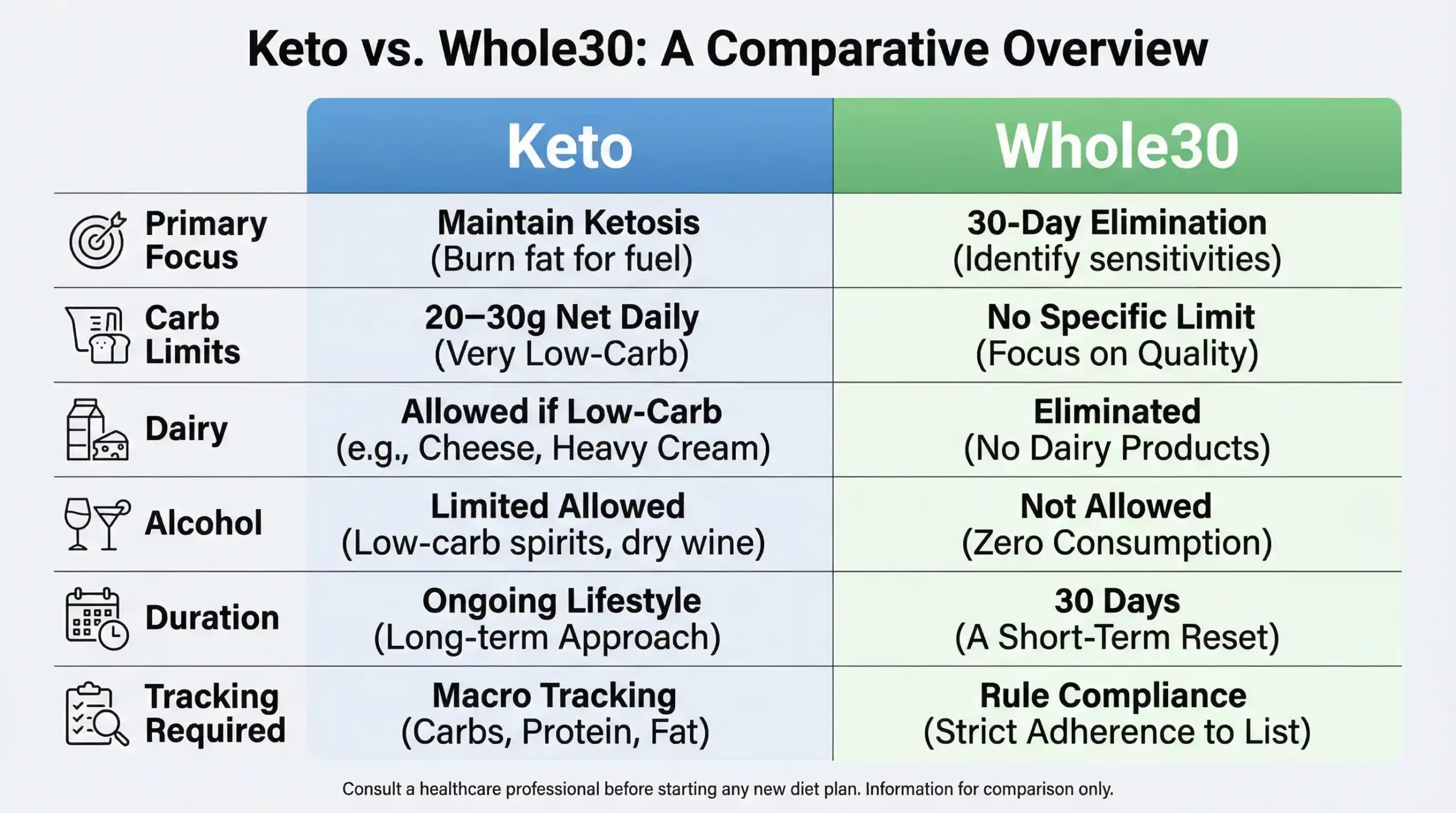
Keto requires consistent carb restriction to stay in ketosis. Whole30 does not care about carb totals at all. A Whole30 meal can be high in carbohydrates if it includes fruit or starchy vegetables, and that is fully compliant.
Approach to Carbohydrates

Carbohydrates are handled very differently between the two plans.
| Carbohydrate Category | Keto | Whole30 |
| Fruit | Very limited, usually berries only | Fully allowed |
| Starchy Vegetables | Usually avoided | Allowed |
| Daily Carb Intake | Typically 20 to 30g net carbs | Often 100g or more depending on choices |
| Percent of Calories from Carbs | 5 to 10 percent | No required percentage |
On keto, carbohydrate restriction is the defining rule. On Whole30, carbohydrates are allowed as long as they come from approved whole foods.
Dairy, Grains, And Legumes
Both plans remove grains and legumes, but for different reasons.
| Food Group | Keto | Whole30 | Reasoning |
| Dairy | Allowed if low-carb | Eliminated | Whole30 removes it during elimination phase |
| Grains | Eliminated | Eliminated | Keto removes for carb control; Whole30 removes for elimination testing |
| Legumes | Eliminated | Eliminated | Keto removes for carb load; Whole30 removes as part of reset |
Dairy is often the biggest practical difference. Keto commonly includes cheese, butter, and heavy cream. Whole30 removes all forms of dairy for the full 30 days.
Duration And Commitment
Keto has no required end date. Many follow it long term and adjust carb intake slightly while staying in ketosis.
Whole30 lasts exactly 30 days. After that, the program moves into reintroduction. It is not designed to stay in strict elimination mode forever.
Flexibility And Sustainability
Keto offers flexibility within macro limits. Someone can adjust fat or protein intake as long as carb intake stays low enough to maintain ketosis.
Whole30 has an all-or-nothing structure for 30 days. There is no flexibility with alcohol, dairy, grains, or sweeteners during that time.
From a lifestyle perspective:
- Keto may require ongoing macro tracking.
- Whole30 requires strict compliance for one month.
- Social events can be challenging for both, but Whole30 allows less room for modification during its active phase.
The structure you prefer often determines which feels more realistic. One plan revolves around numbers. The other revolves around rules.
Lifestyle And Practical Considerations
Choosing between keto and Whole30 is not just about food lists. Daily logistics matter. Grocery shopping, meal prep, social events, and the learning curve all shape whether someone sticks with a plan.
Meal Planning And Grocery Shopping
Both plans require more attention at the store, but for different reasons.
On keto, the focus is on carb counts. Even foods labeled “healthy” can contain hidden carbohydrates. Sauces, dressings, nuts, and packaged snacks can push someone over their daily limit quickly. Most keto followers check:
- Total carbohydrates per serving
- Fiber to calculate net carbs
- Portion size
On Whole30, the focus shifts from macros to ingredient labels. Sugar hides under many names. Soy, dairy derivatives, and additives appear in packaged foods that seem compliant at first glance. Whole30 shoppers typically scan for:
- Added sugars of any kind
- Soy ingredients
- Dairy ingredients
- Grain-based fillers
Both plans naturally push people toward cooking at home. Packaged convenience foods often contain restricted ingredients or too many carbs.
Eating Out And Social Events
Restaurants can be managed on either plan, but the strategy differs.
On keto, people often modify meals. They might replace fries with salad, skip the bun, or request extra vegetables instead of starch. Alcohol is allowed in limited low-carb forms such as dry wine or spirits without sugary mixers.
On Whole30, the restrictions are tighter during the 30 days. Alcohol is not permitted at all. Cooking oils, marinades, and hidden ingredients become concerns. Even small amounts of sugar or soy sauce make a dish non-compliant. This can make dining out more complicated, especially in chain restaurants where ingredients are pre-set.
Social gatherings can feel restrictive on both plans. Keto allows more macro-based adjustments. Whole30 requires full compliance for the duration of the program.
Learning Curve
Each plan has its own learning curve.
| Skill Required | Keto | Whole30 |
| Macro Tracking | Yes, daily | No |
| Ingredient Rule Awareness | Moderate | High |
| Early Adaptation Phase | 1 to 2 weeks for ketosis adjustment | Immediate rule compliance |
| Long-Term Monitoring | Ongoing carb management | Post-program food awareness |
Keto requires understanding how carbohydrates affect ketosis. Many people spend the first week learning to track net carbs accurately.
Whole30 requires memorizing food rules and applying them strictly for 30 days. There is less math, but more label scrutiny.
In practical terms, keto demands numeric awareness. Whole30 demands rule discipline. Which one feels easier depends on whether someone prefers tracking numbers or following firm boundaries.
Similarities Between Keto And Whole30

Keto and Whole30 are structured differently, but they share several foundational principles. That overlap is one reason people compare them so often.
Both plans remove added sugar. This includes obvious sources like soda and desserts, but also hidden sugars found in sauces, dressings, and packaged snacks. For many people, cutting added sugar alone leads to fewer cravings and more stable energy.
Both eliminate grains and legumes. Wheat, rice, oats, corn, beans, lentils, and soy are excluded on both plans. The reasoning differs, but the outcome is similar. Highly processed grain-based foods are removed from the daily menu.
Both shift attention toward whole foods. Meals tend to center around:
- Meat, poultry, and seafood
- Eggs
- Vegetables
- Natural fats
This shift often leads to cooking more meals at home. Restaurant and packaged foods frequently contain restricted ingredients or hidden carbohydrates, so both plans reward simple, home-prepared meals.
Both reduce intake of ultra-processed foods. Chips, candy, pastries, and packaged snack foods rarely fit into either structure. As a result, many people experience a reduction in highly refined carbohydrate intake.
Where they differ is in purpose and execution. Where they overlap is in food quality. Both plans remove common trigger foods and increase awareness of what goes into each meal.
Choosing Between Keto And Whole30
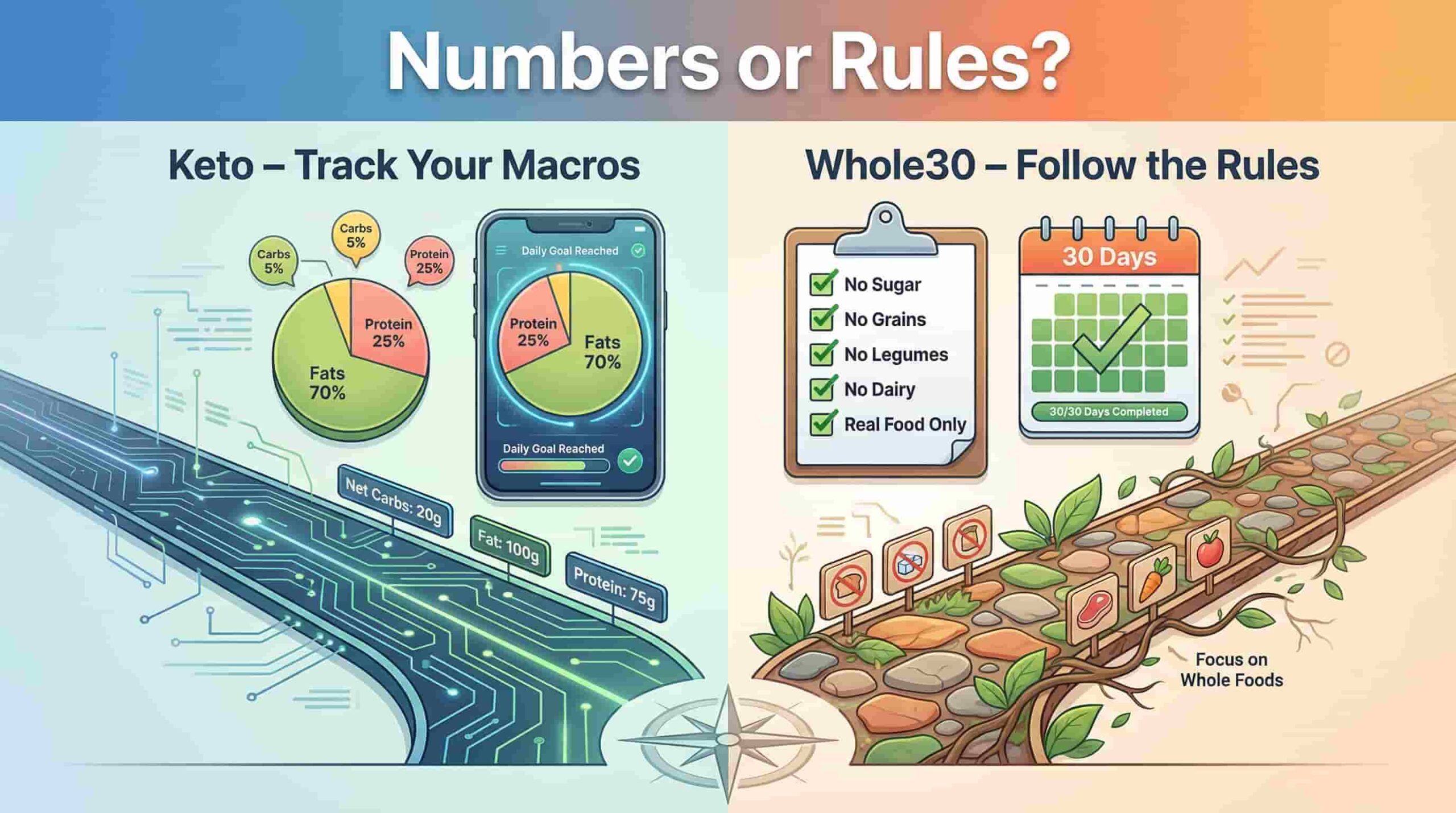
Choosing between keto and Whole30 comes down to personal preference, structure tolerance, and long-term goals. Neither plan is universally better. Each works well for different types of people.
Preference for Structure vs Simplicity
Keto suits people who are comfortable tracking numbers. Carb limits are clear. Staying under 20 to 30 grams of net carbs per day becomes the main target. If someone prefers measurable guidelines and does not mind using a tracking app, keto often feels straightforward.
Whole30 suits people who prefer firm boundaries without calculations. There are no macros to hit. A food is either compliant or it is not. That simplicity appeals to people who want clear rules without daily math.
Short-Term Reset vs Long-Term Framework
The time horizon matters.
| Goal | Keto | Whole30 |
| Designed for 30 Days | No | Yes |
| Intended as Long-Term Pattern | Yes | Not in strict form |
| Structured Reintroduction Phase | No | Yes |
Whole30 is built as a defined 30-day reset followed by structured reintroduction. Keto has no required endpoint. Many treat it as a long-term low-carb framework.
If someone wants a short reset with a clear finish line, Whole30 fits that goal. If someone wants an ongoing metabolic strategy centered on ketosis, keto fits better.
Personal Food Preferences
Food preference often makes the decision easier.
- Comfortable eating higher-fat meals with cheese and cream
- Comfortable removing dairy completely
- Prefer fruit flexibility
- Comfortable tracking carbs daily
Someone who enjoys full-fat dairy and does not mind limiting fruit may lean toward keto. Someone who wants fruit and is willing to remove dairy for a month may prefer Whole30.
In the end, adherence determines results. The better plan is the one that fits daily life, aligns with food preferences, and feels realistic to maintain.
Conclusion
Keto and Whole30 may look similar at first glance, but they are built on very different foundations. Keto centers on macronutrient control and maintaining ketosis through consistent carbohydrate restriction. Whole30 centers on a 30-day elimination structure, followed by a careful reintroduction process to evaluate how specific foods affect daily life.
Throughout this comparison, a few key insights stand out. Keto requires ongoing carb awareness and works best for those comfortable tracking numbers and building meals around fat and protein. Whole30 removes more food groups up front, including dairy and alcohol, and asks for strict compliance for a defined period. One plan offers long-term structure. The other offers a contained reset.
The benefits of each plan depend heavily on personality and preference. Keto provides clarity through measurable targets. Whole30 provides clarity through firm boundaries. Both reduce added sugar, remove grains and legumes, and shift attention toward whole, home-prepared meals. Both increase awareness of ingredients and food quality.
One perspective worth considering is this: the choice does not always have to be permanent. Some people use Whole30 as a structured reset before transitioning into a lower-carb framework. Others follow keto long term but occasionally run short elimination phases to reassess food tolerance. These approaches are not mutually exclusive. They can serve different purposes at different times.
If you are unsure which path fits best, start by examining your habits. Do you prefer numbers or rules? Do you want a defined start and finish, or an ongoing system? Try one approach with clear intention and observe how it fits your routine, cooking style, and social life.
The most effective plan is the one that aligns with your structure preference, food comfort level, and long-term consistency. Experiment thoughtfully, adjust as needed, and choose the framework that feels realistic for your daily life.
Source link